Polish Medcom’s drive system to accompany Solaris into the North American market
Solaris’s entry into the North American market could represent a major step forward not only for the Polish bus manufacturer, but also for the Polish supply industry: the propulsion technology for the new family of 40- and 60-foot electric buses will be provided – as with the Trollino trolleybuses being built for Vancouver – by Warsaw-based Medcom. The company’s new-generation modular drive system, based on silicon carbide semiconductors, has been specifically adapted to the requirements of the North American market. However, the significance of the cooperation extends beyond technical development, as Medcom could also prepare for local production of the drive systems by drawing on the US manufacturing capacity of Japan’s Mitsubishi Electric. This may be particularly important for Solaris, as buses procured with federal funding in the United States must meet strict domestic manufacturing and local-content requirements.
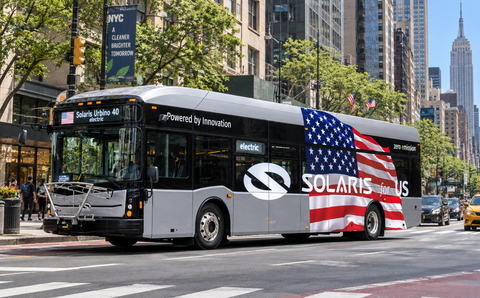
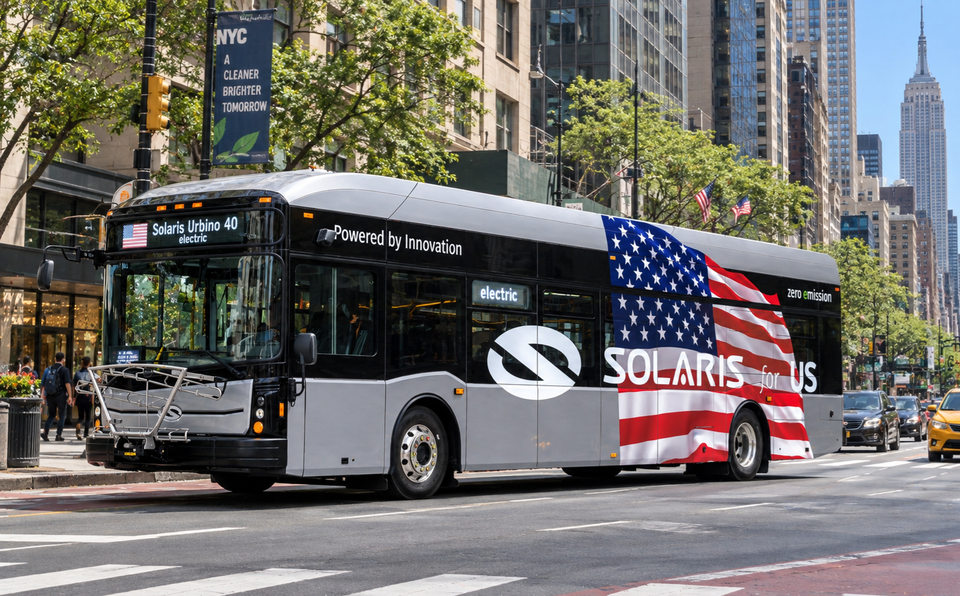
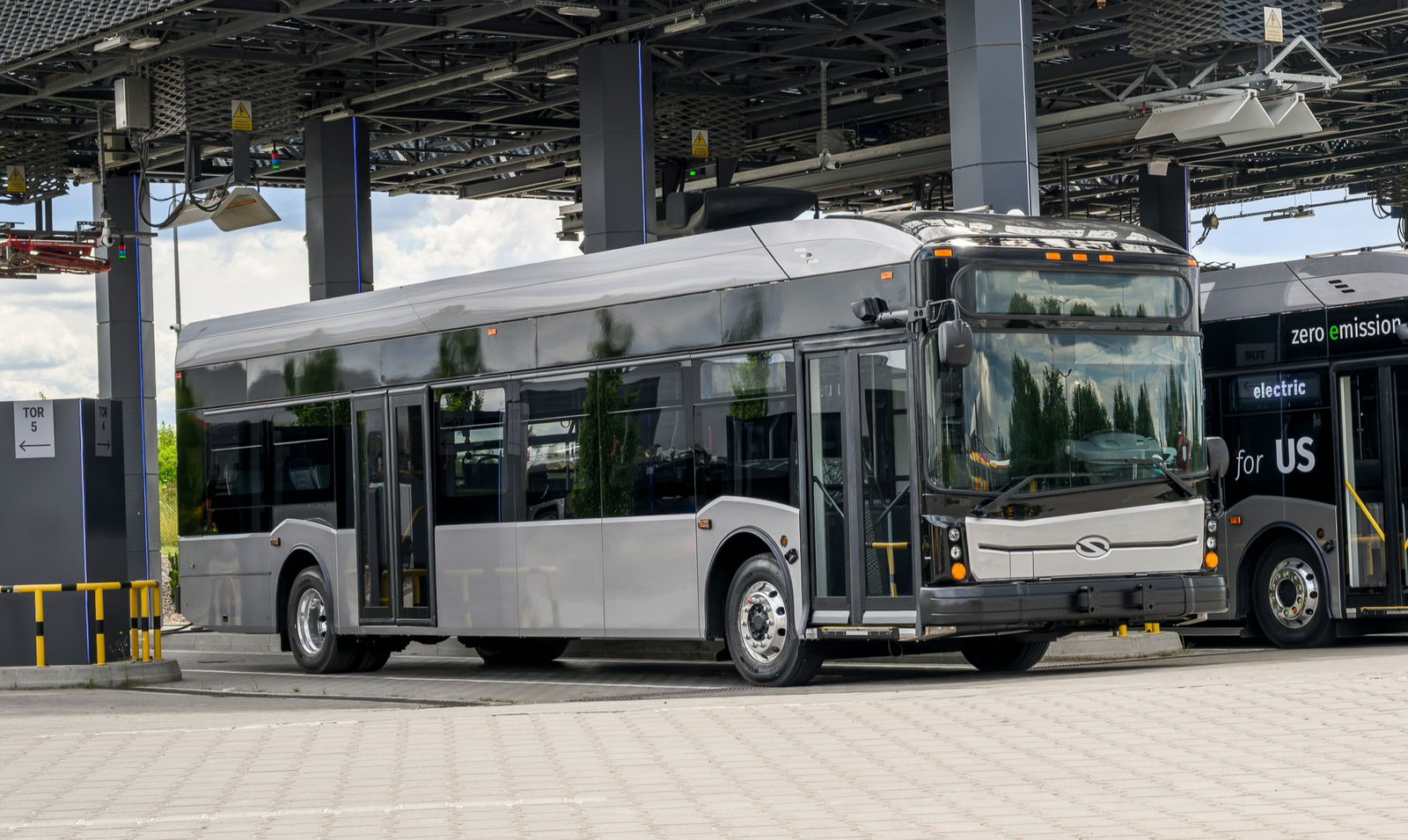
As we reported in detail previously, Solaris unveiled its first urban electric bus developed specifically for the North American market at the APTA TRANSform & EXPO exhibition in Chicago on 5 October. With the introduction of the 12.19-metre Urbino 40 electric and the 18.29-metre articulated version due to follow later, the Polish manufacturer has entered a market characterised by specific technical and regulatory requirements, as well as the strong positions of local manufacturers. The first ten vehicles were ordered by King County Metro, which operates in the Seattle area, and San Francisco’s SFMTA, while the US basis for subsequent series production could be provided by the Elmira plant in New York State operated by Solaris’s Spanish parent company, CAF.
The modular drive system supplied by Medcom and based on silicon carbide semiconductors is responsible for operating one larger centrally mounted electric motor in the single-deck version and two lower-output centrally mounted electric motors in the articulated version. One of the most important features of the SiC Modular Drive System is the flexible installation of its power-electronic units. Unlike conventional designs, the traction inverters, auxiliary converters and high-voltage distribution equipment do not need to be integrated into a single equipment assembly, but can be installed separately at different points of the vehicle, providing greater design freedom. The use of silicon carbide semiconductors also enables lower switching losses, more compact equipment and reduced cooling requirements compared with conventional silicon-based solutions.
Another European supplier is also likely to play a role in the driveline of Solaris’s North American vehicles. The Polish bus manufacturer’s currently exclusive supplier of electric motors is Austria’s Traktionssysteme Austria (TSA), which also maintains close propulsion-system cooperation with Medcom. On this basis, it is likely that Solaris will also use the tried-and-tested Austrian electric motors in the model family developed for the US market, although the manufacturer of the motors for the 40- and 60-foot models has not yet been officially named.
However, entering the North American market presents Solaris’s European suppliers with new challenges not only in technical terms, but also in terms of production organisation. For Medcom, its close cooperation with Japan’s Mitsubishi Electric may therefore be particularly important, enabling it to draw on manufacturing capacity available in the United States.
The relationship between the two companies extends far beyond conventional business cooperation. Mitsubishi Electric is preparing to acquire Medcom in full: in August, the Japanese group announced that it would increase its 49% stake, held since 2016, to 100% by purchasing the remaining 51%. However, the acquisition, which is subject to regulatory approvals, would not entail the loss of the Polish company’s independence: Medcom would continue to operate under its own brand name and retain its organisational structure, while also being able to draw on Mitsubishi Electric’s global manufacturing and sales network.
A US manufacturing base may be particularly important because of Buy America regulations, which require at least 70% US component content and final assembly in the United States for bus procurements financed through federal funding. Solaris’s initial US orders are still exempt from these requirements, but participation in later, higher-volume procurements will require appropriately localised manufacturing and supplier capacity. No specific details have yet been disclosed regarding the possible US production of Medcom’s propulsion equipment.
Alongside its propulsion solutions, Medcom also presented a proprietary mobile electric bus charging unit based on SiC technology at the Mitsubishi Electric Power Products stand at the Chicago exhibition, signalling that it is also seeking opportunities in the field of charging infrastructure in the North American market.