Solaris unveils its North American electric bus range
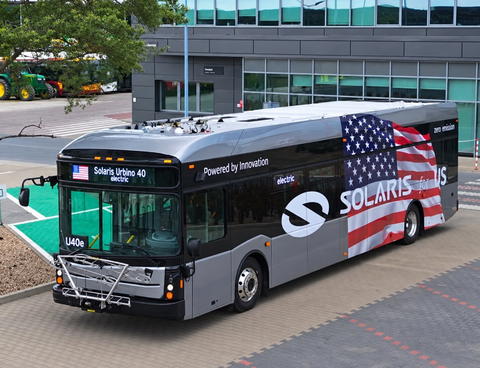
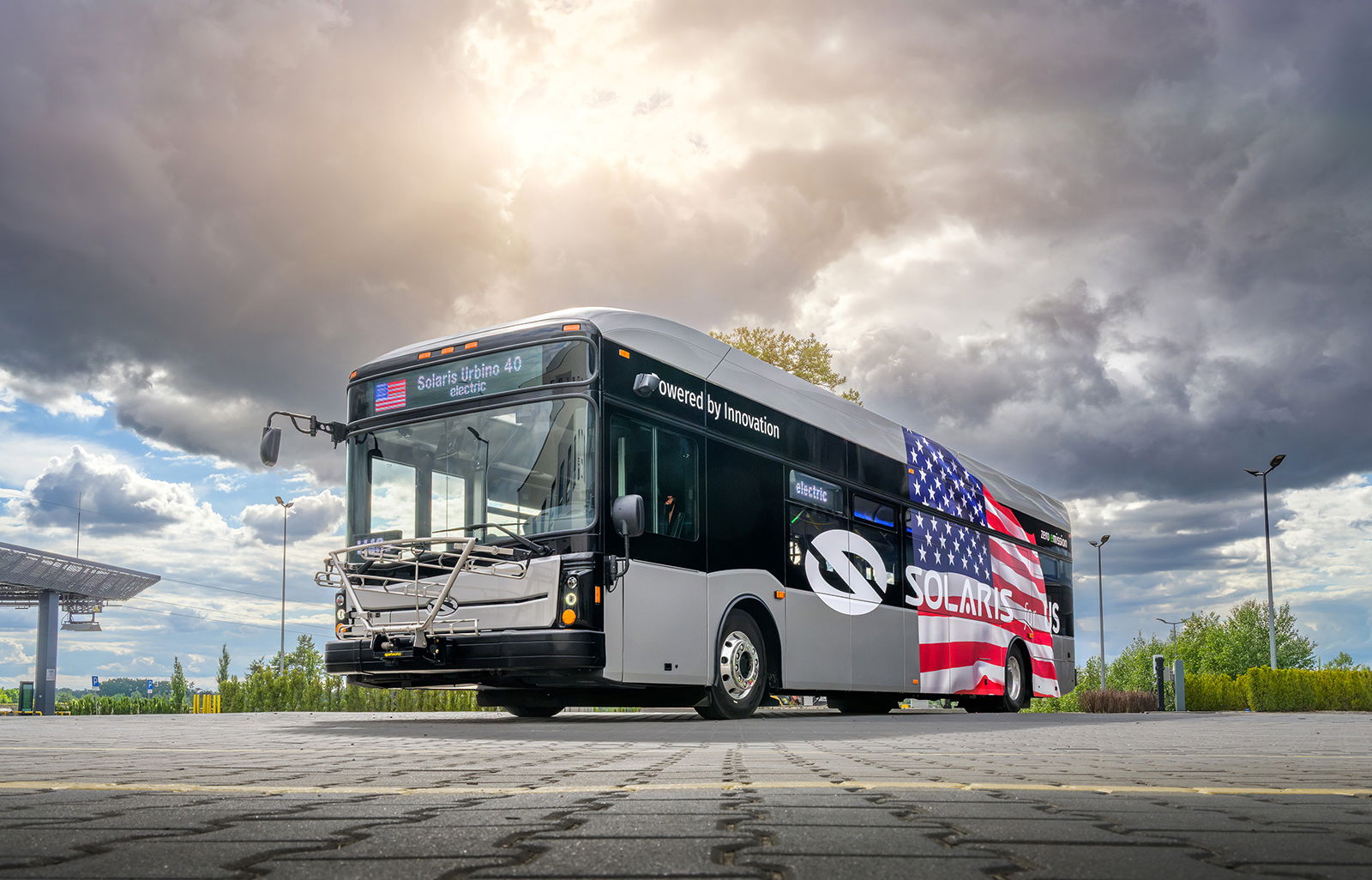
At 3 p.m. local time on 5 October, the professional audience at Chicago’s APTA TRANSform & EXPO exhibition witnessed an event of historic significance for the industry: after countless computer renderings becoming increasingly refined and progressively closer to the final design, followed by an increasing number of details, and finally images and videos showing the entire vehicle, Solaris’s brand-new standard-length urban electric bus for the North American market, the Urbino 40 electric, was finally unveiled in physical form. The event marks an extremely important milestone in the history of the Polish bus manufacturer, which has now officially entered the rather distinctive and closed North American urban bus market, where it is currently the only European-based manufacturer competing against mainly US and Canadian rivals.
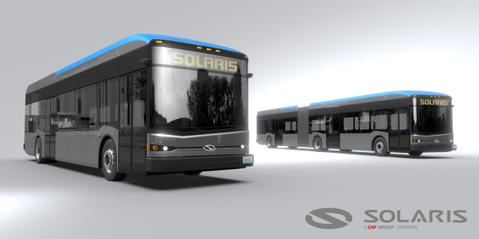
The North American version of the Urbino range will be offered in line with local market requirements as a 40-foot (12.19-metre) standard-length model and a 60-foot (18.29-metre) articulated version, both with a width of 2.59 metres and a height of 3.43 metres. As we reported previously, the first customer vehicles of the type will enter service with King County Metro, serving the Seattle area, and with the San Francisco transport operator SFMTA. These initial procurements are not yet subject to the strict provisions of the Buy America legislation, which requires a high US content for buses purchased with federal funding, so the first vehicles will still be built in Poland. In the longer term, however, Solaris’s parent company, CAF, will serve the US market from its plant in Elmira, New York, USA.
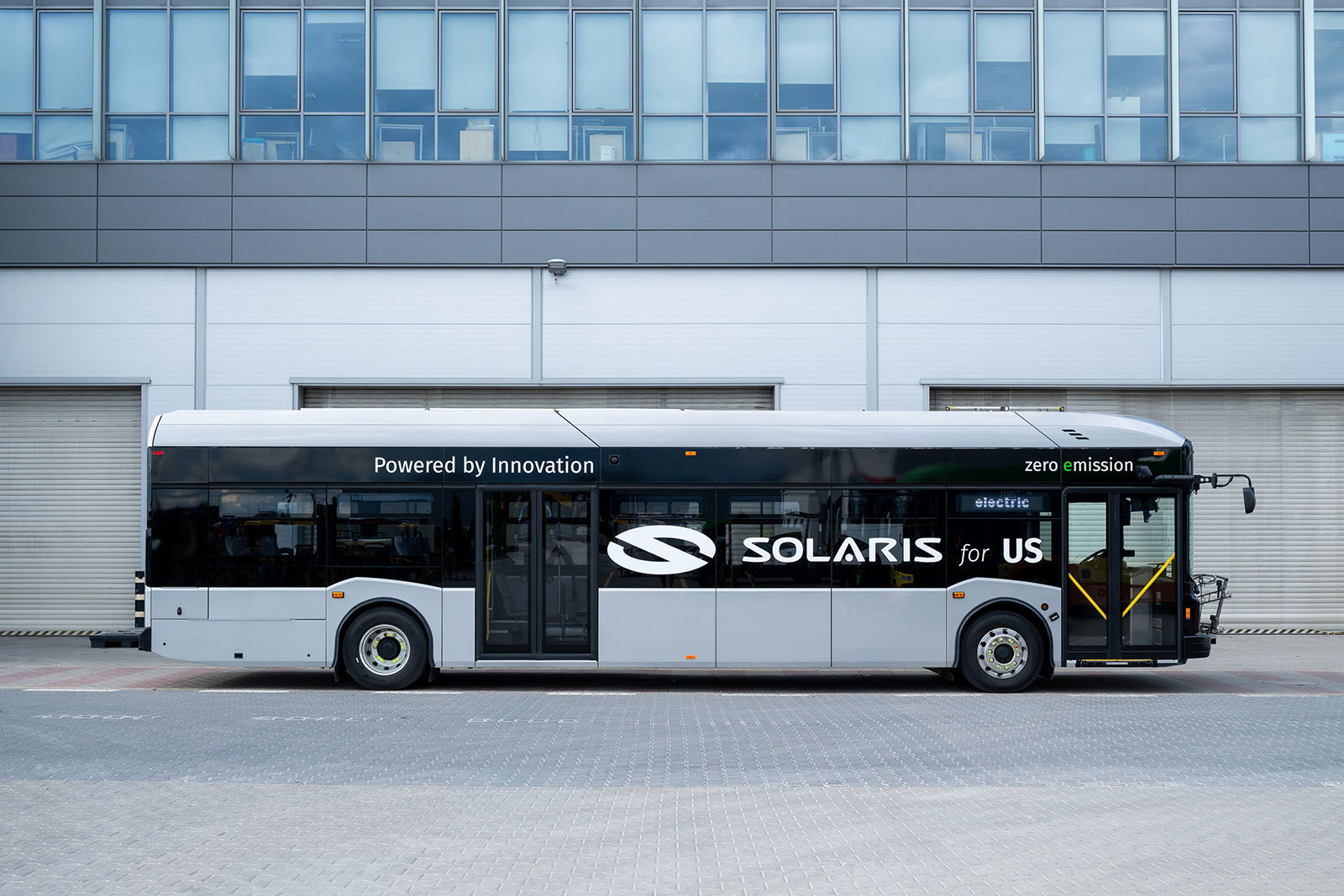
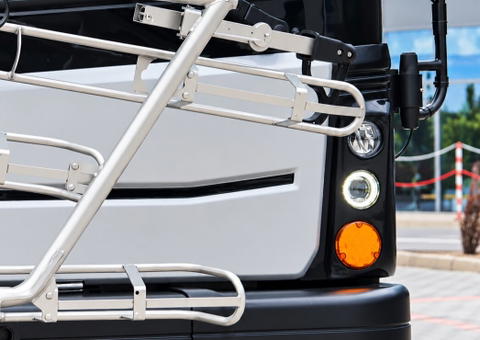
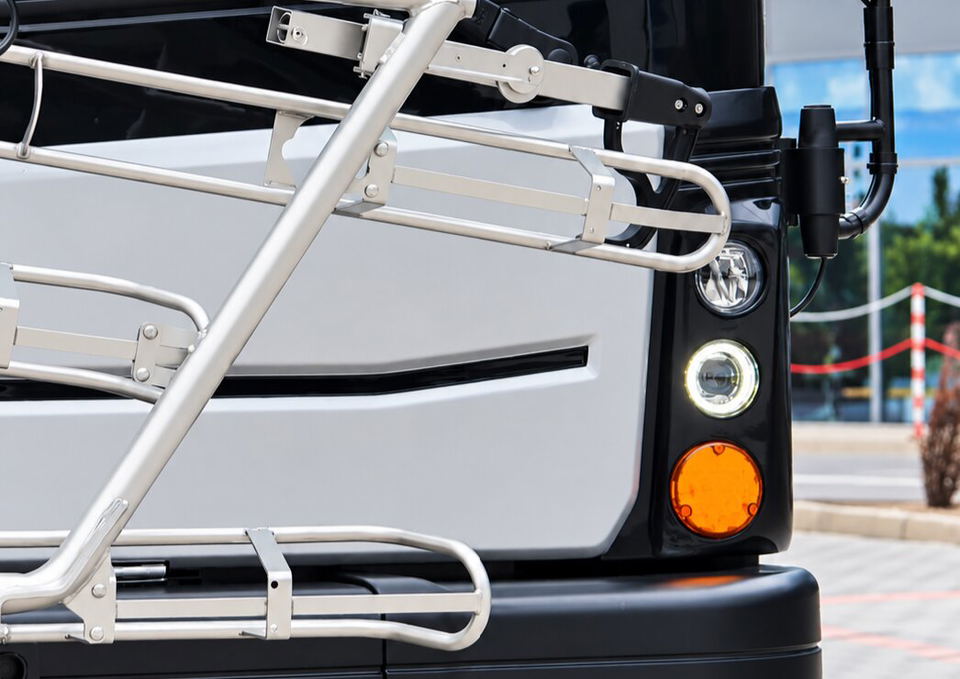
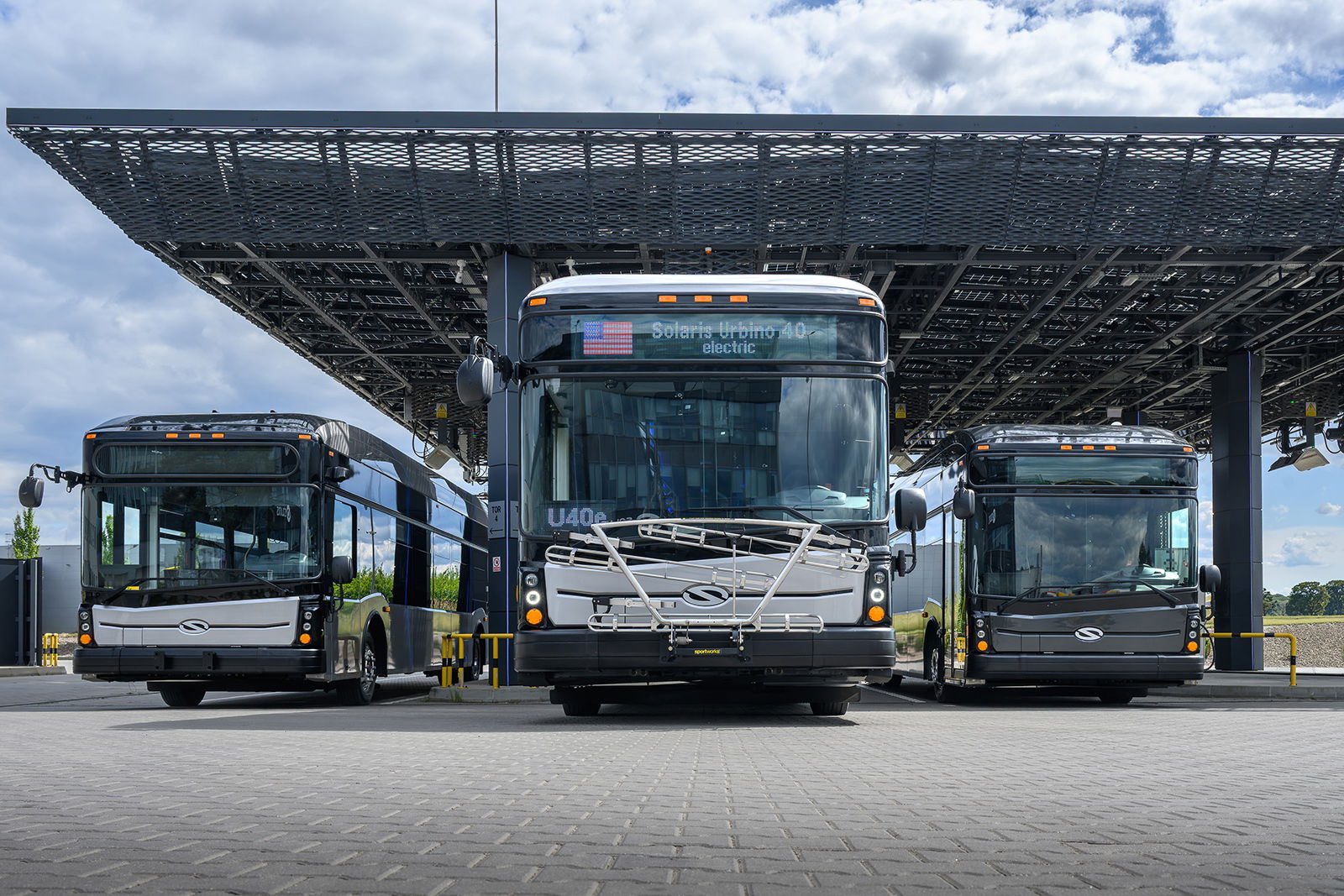
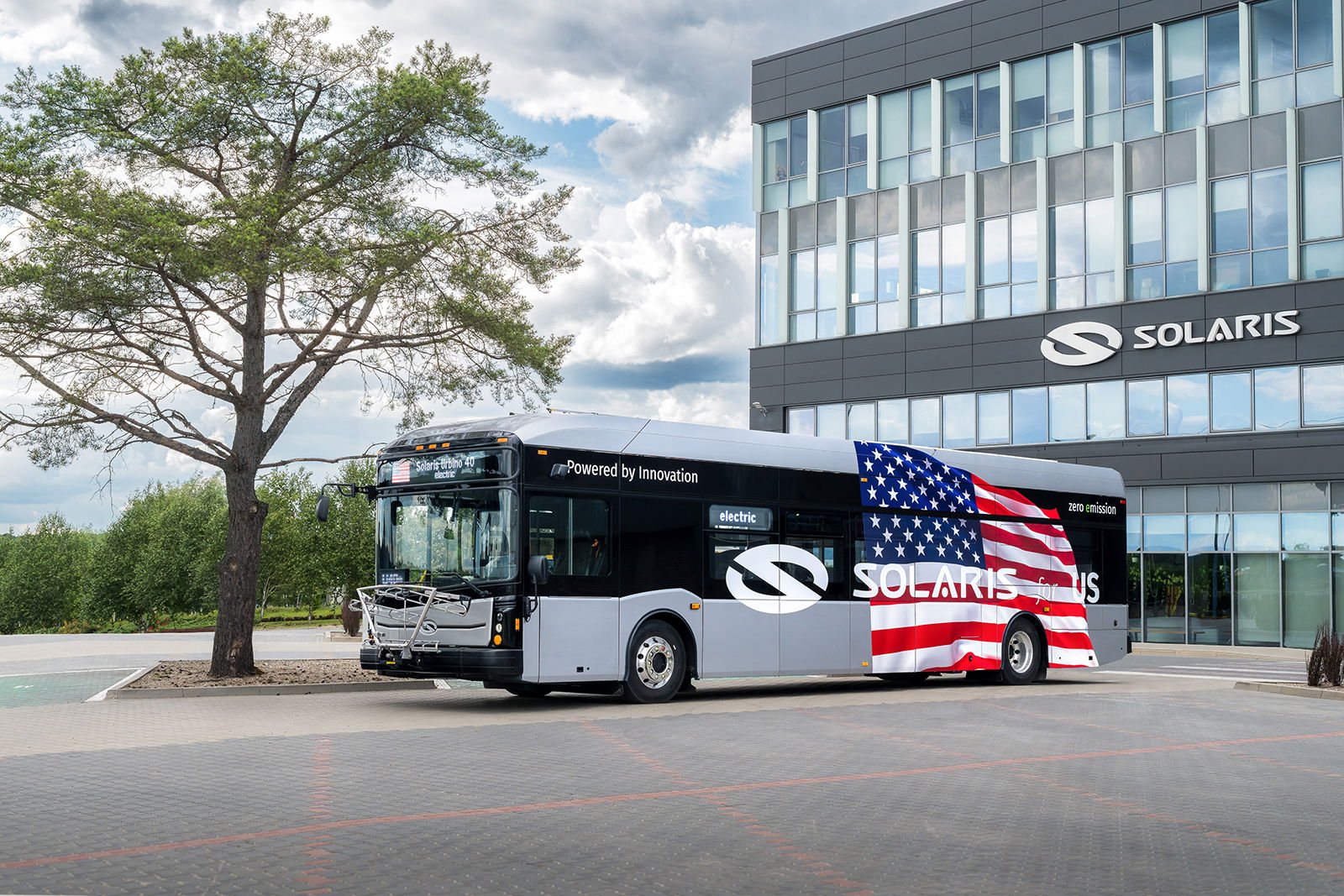
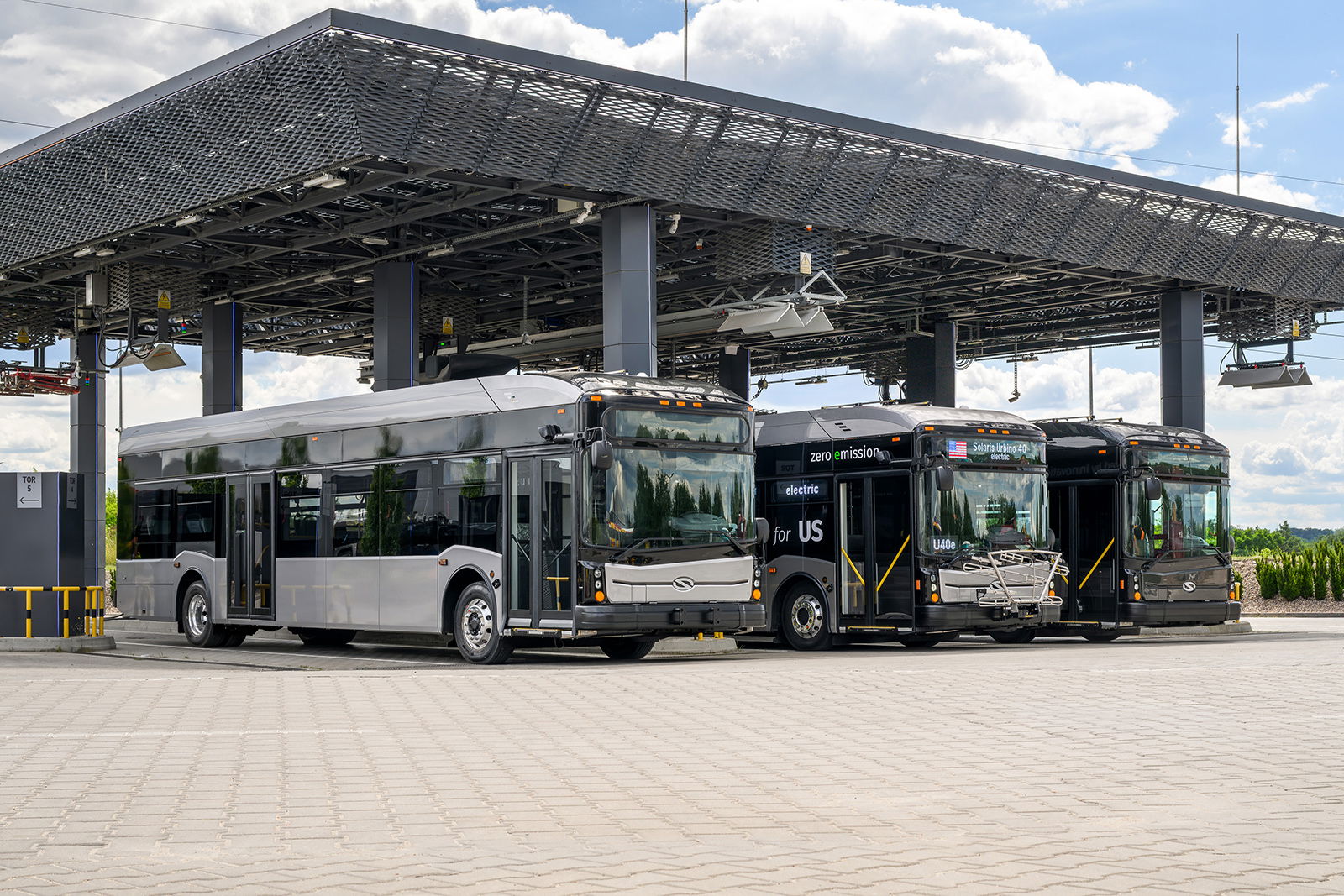
Following the teaser images and videos released recently, the exterior holds few surprises: despite the front and rear ends being fitted with the lights required by local regulations, including cornering lights, and large energy-absorbing bumpers, the Solaris identity is clearly recognisable in profile thanks to the vertical division of the side panelling and the pronounced wheel arches. Although they form a continuous band when viewed from the outside, the side windows are in fact rubber-mounted and designed to be pushed out in an emergency. Typically North American extras are also available for the type, including a bicycle rack mounted on the front bumper, in this case manufactured by Sportworks.
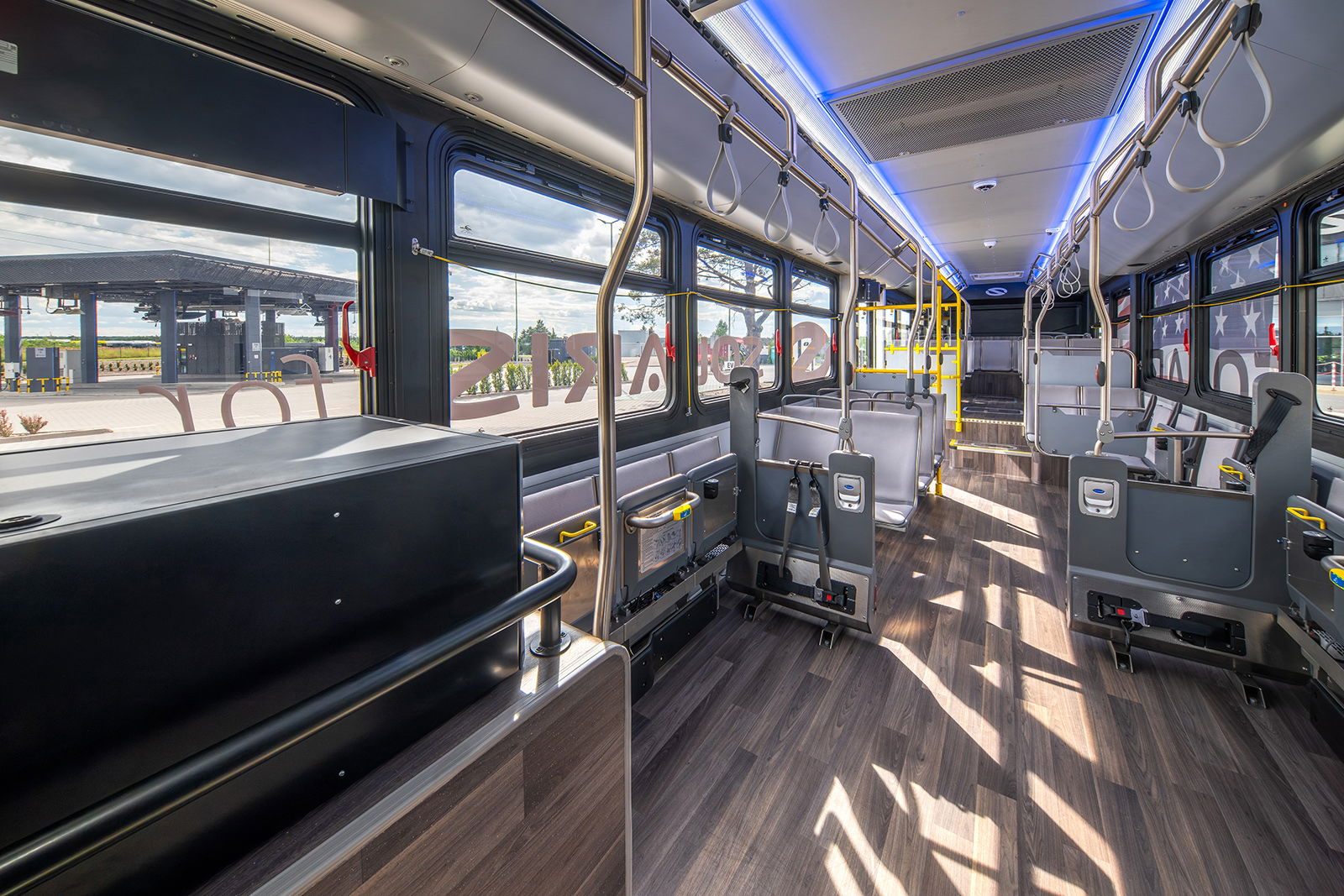
The standard-length example presented in Chicago has a 2-2-0 door arrangement, with a wheelchair ramp installed at the front door, as is customary in this category in North America. The low-entry passenger compartment, with its characteristically American layout, can accommodate up to 41 passenger seats, 22 of which can be reached without stepping onto a platform; there is also provision for two wheelchair spaces fully compliant with local ADA requirements. The articulated version, which was not shown at the world premiere, is supplied as standard with a 2-2-2-0 door layout, up to 51 passenger seats, 33 of them without a platform step, and two likewise ADA-compliant wheelchair spaces. Supporting Polish industry, the demonstrator is fitted with Ster INOX passenger seats. To ensure a wide gangway, a significant proportion of these have been installed transversely to the direction of travel, both in the low-floor section and at the rear of the passenger compartment, another frequent choice among local operators. The wood-effect flooring and blue ambient lighting provide welcome relief among American urban buses that are often almost offensively functional – although it remains to be seen how much of this will be retained on subsequent production vehicles built to customer order. The condenser unit of the energy-efficient air-conditioning system is located behind the rear row of seats, meaning that the bus has no rear window.
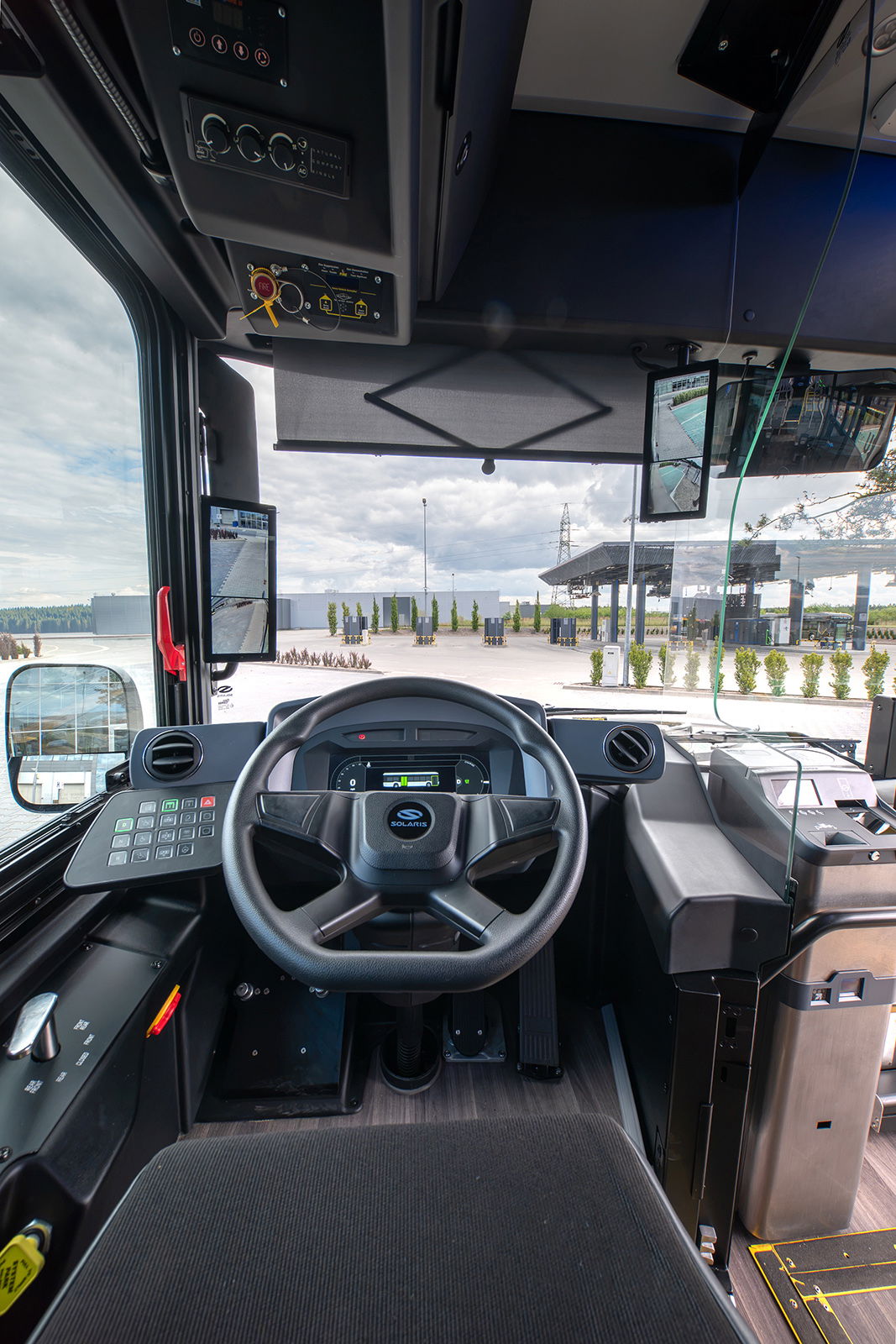
According to Solaris, great emphasis was placed on driver safety and comfortable working conditions during development. Accordingly, the driver’s cab is fully enclosed, while the exterior rear-view mirrors are replaced by digital cameras, although the buses shown in the manufacturer’s press photographs also feature conventional mirrors, namely American-style lower-mounted units on the driver’s side. The demonstrator is fitted with Continental’s – now AUMOVIO’s – modular dashboard, paired with a robust, typically American steering wheel flattened at the bottom, creating an interesting contrast. Also a North American feature is the parking brake valve operated by a yellow push-pull lever, and the direction indicators operated by floor-mounted foot switches rather than a stalk, allowing the driver to keep both hands on the steering wheel at all times while manoeuvring. Accident prevention is further assisted by advanced driver-assistance systems, while the vehicle monitoring systems provided by Solaris make efficient work organisation easier for the operator.
For greater safety and easier maintenance, the traction batteries, featuring an integrated battery thermal management system (BTMS), are roof-mounted. Their total capacity is 528 kWh in the standard-length version, provided by three 176 kWh battery modules based on lithium iron phosphate (LFP) cell chemistry, while the articulated version has four such modules with a total capacity of 704 kWh. According to Solaris, this provides both variants with a range of slightly more than 150 miles (240 kilometres). The manufacturer has so far released few details on charging methods; however, for conventional plug-in charging, two connectors have been provided at the rear of the vehicle, one on each side. In addition, the charging rails mounted on the roof of the demonstrator indicate that inverted-pantograph fast charging will also be possible. The standard-length model is driven by one centrally mounted electric motor, while the articulated version has two; their output has not been disclosed, but both versions are said to be capable of accelerating to a respectable top speed of 65 mph (104 km/h). Solaris has also specified the gradeability of the standard-length version as 20%. The axles are supplied by ZF: the rigid front axle is an RL 82 A, the driven rear axle is an A 133, while an AV 133 portal unit is used as the centre axle of the articulated version.
The financial background to the first US orders is also known, and the vehicles are rather expensive. The total value of the two 40-foot and two 60-foot electric Solaris buses being built for King County Metro is $5.77 million: the standard-length version costs $1.22 million apiece, equivalent to around HUF 400 million, while the articulated version costs $1.66 million, or nearly HUF 543 million. The three vehicles of each length subsequently ordered by the San Francisco Municipal Transportation Agency (SFMTA) are even more expensive: it will pay $1.41 million apiece, around HUF 461 million, for the 40-foot version, and $1.86 million, approximately HUF 608 million, for the 60-foot model. When assessing these high unit prices, it is worth bearing in mind that the type is still being introduced to the market in small volumes, while the first examples will also still be built in Poland. Together, the two orders represent ten Solaris electric buses; delivery of the vehicles destined for Seattle is expected by the end of 2026, while the San Francisco examples are due in spring 2027.
Since its foundation 30 years ago, Solaris, which has been part of Spain’s CAF Group since 2018, has delivered around 30,000 buses to 900 cities in 34 countries worldwide, and today its range is clearly dominated by zero-emission vehicles with alternative propulsion systems – battery-electric and hydrogen fuel-cell buses, as well as trolleybuses. The company’s North American bus portfolio now being developed is expected to complement CAF’s long-established and successful rail operations across the Atlantic, particularly in the United States.
Photos: Solaris Bus & Coach