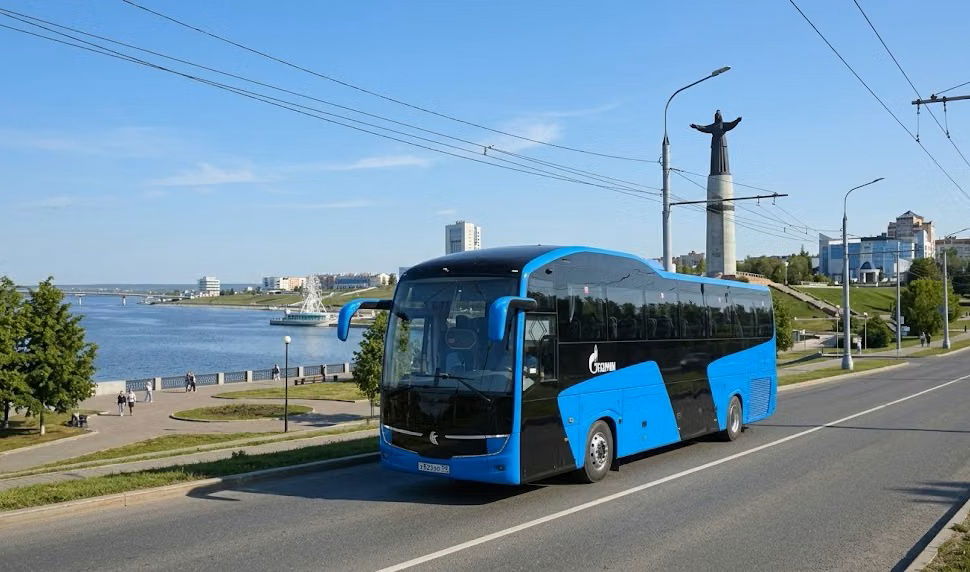
Russian bus manufacturers preparing for a stronger presence in the coach segment
Russian bus manufacturers have traditionally been most active in the midibus and urban solo and articulated segments, but recent news points to significant activity in the long-distance sector as well. Currently this part of the Russian market – as is clearly evident from the annual sales figures – is dominated by Chinese manufacturers, led by Yutong, but domestic brands may soon play a greater role here too: KAMAZ has announced that series production of its newly developed CNG-powered coach will begin next year, while Sollers has recently announced both a greater Russian contribution and the relocation of production.
KAMAZ is planning to begin series production of coaches in 2027, according to Sergey Kogogin, the company’s CEO, speaking to the TASS news agency at the COMTRANS 2026 exhibition held in Kazan between 22 and 25 September. As we reported at the time, the Russian manufacturer unveiled the prototype of the CNG-powered KAMAZ-52229 coach (shown in our cover image), part of its new A5 model range, at the St Petersburg International Gas Forum last autumn. The air-conditioned interior of the vehicle, which is equipped with 47 seats, includes a refrigerator, toilet, numerous USB charging points, a security camera system and a sleeping berth reserved for the driver. It is powered by KAMAZ’s own 320 hp (235 kW) natural gas engine, which drives the rear wheels via an automated gearbox. According to the manufacturer, the bus also features a number of active driver-assistance safety functions (ADAS). The roof-mounted CNG tank unit, with a total capacity of 1,110 litres, provides a range of at least 500 kilometres, although this can be increased to 650 kilometres by fitting additional gas tanks.
A pre-production batch of the type – whose first operator is expected to be Gazprom – was also completed this year and is currently undergoing testing. According to Kogogin, the decision on the start of series production will be based on the test results, but at present they expect to meet the 2027 target date.
One day later, on 23 September, Viktor Zornikov, Sollers’ Director of Technological Development, informed the daily newspaper Izvestia about the reorganisation of production at the company, which offers specifically interurban and long-distance bus models (as well as off-road vehicles, pick-ups and various light commercial vehicles). Under the plans, bus production will be moved from the former Mazda plant in Vladivostok, where bus assembly based on a Chinese Ankai licence began in 2024, to the Ulyanovsk plant that produces the UAZ off-road vehicles also known in Hungary. Sollers’ full-size buses are in fact rebadged Ankai models: the 12-metre-long, 51-seat SA9 flagship model competes in the full size coach category, while the similarly Euro 5-compliant but slightly less powerful, diesel-engined and lower-floor SA6 range, available in two length variants, competes for customers in the interurban segment. This year’s COMTRANS exhibition also saw the presentation of the smallest member of the product range to date: the SF7 minibus, based on a light van and capable of carrying 21 passengers.
When production began two years ago, Sollers’ management set ambitious targets of manufacturing 1,500 buses annually – according to statistics from the Russian agency Autostat, it had managed to sell 35 Sollers SA9 coaches by the end of last year. The move of bus production to Ulyanovsk is expected to be completed by 2028, while the chairman of the company’s board of directors, Adil Shirinov, confirmed that, in line with localisation efforts, the bodies of the buses will by then be manufactured entirely in Russia.
Cover image: www1.ru